 Crowdswap
 fees vary by swap route and published strategy
Crowdswap fees depend on whether you're swapping tokens or using a published liquidity strategy. Swaps can involve a platform charge, the fee that the underlying pool charges, and network execution costs. A cross-chain route also has its own protocol charges. Strategy creators choose a separate fee for using their published rules. CrowdWallet's option to pay gas with the traded token changes how you pay that cost.
· last updated
Routing, swap contracts, and pools handle different cost components
The router selects an exchange path, the swap contract collects the platform charge, and the underlying pool applies its trading fee. The swap estimate reports the platform rate in crowdswapFeePercentage and the underlying exchange's rate in currentDexFeePercentage. Network execution adds another cost, which reflects the blockchain operations involved. A platform percentage alone therefore doesn't describe everything that affects the amount available after a swap.
Pool selection matters even when the starting and destination tokens stay the same. Uniswap v3 allows pools for the same pair with different fee tiers. The fee that a selected pool charges belongs to that pool's configuration. It doesn't establish the platform's charge or the cost of executing the route.
Cross-chain charges include destination execution
On the gateway-based cross-chain route, validator charges and destination execution join the protocol's variable fee. Users of the gateway-based cross-chain route pay destination execution costs to the gas-service contract on the source chain.
The documented CROWD-based route also calculates output using destination-side CROWD liquidity. That liquidity affects the exchange outcome separately from explicit protocol charges. A fixed validator charge and a variable protocol charge scale differently. The fixed component consumes a larger share of a smaller transfer, while the variable component scales with the amount.
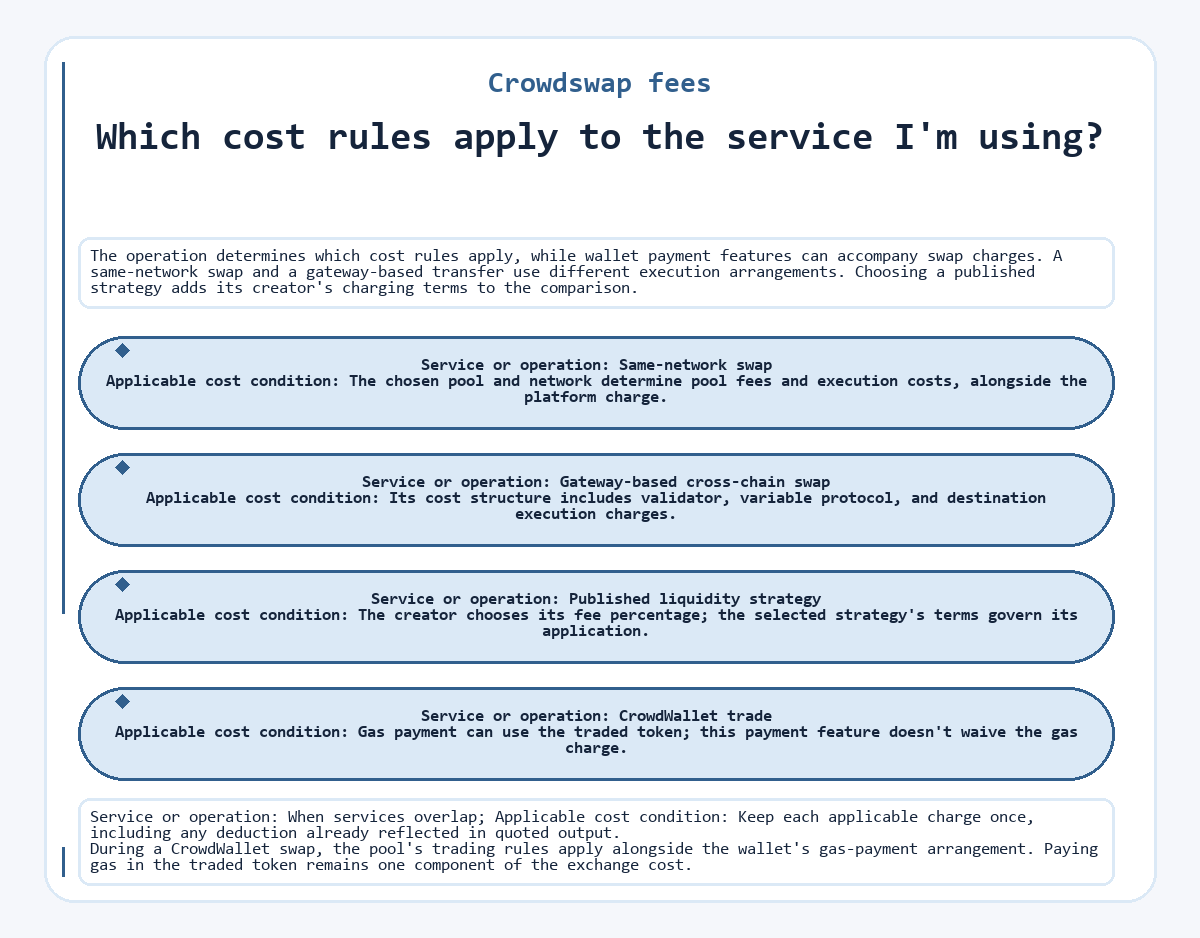
Which cost rules apply to the service I'm using?
The operation determines which cost rules apply, while wallet payment features can accompany swap charges. A same-network swap and a gateway-based transfer use different execution arrangements. Choosing a published strategy adds its creator's charging terms to the comparison.
| Service or operation | Applicable cost condition |
|---|---|
| Same-network swap | The chosen pool and network determine pool fees and execution costs, alongside the platform charge. |
| Gateway-based cross-chain swap | Its cost structure includes validator, variable protocol, and destination execution charges. |
| Published liquidity strategy | The creator chooses its fee percentage; the selected strategy's terms govern its application. |
| CrowdWallet trade | Gas payment can use the traded token; this payment feature doesn't waive the gas charge. |
| When services overlap | Keep each applicable charge once, including any deduction already reflected in quoted output. |
During a CrowdWallet swap, the pool's trading rules apply alongside the wallet's gas-payment arrangement. Paying gas in the traded token remains one component of the exchange cost.
Creator fees follow the selected strategy
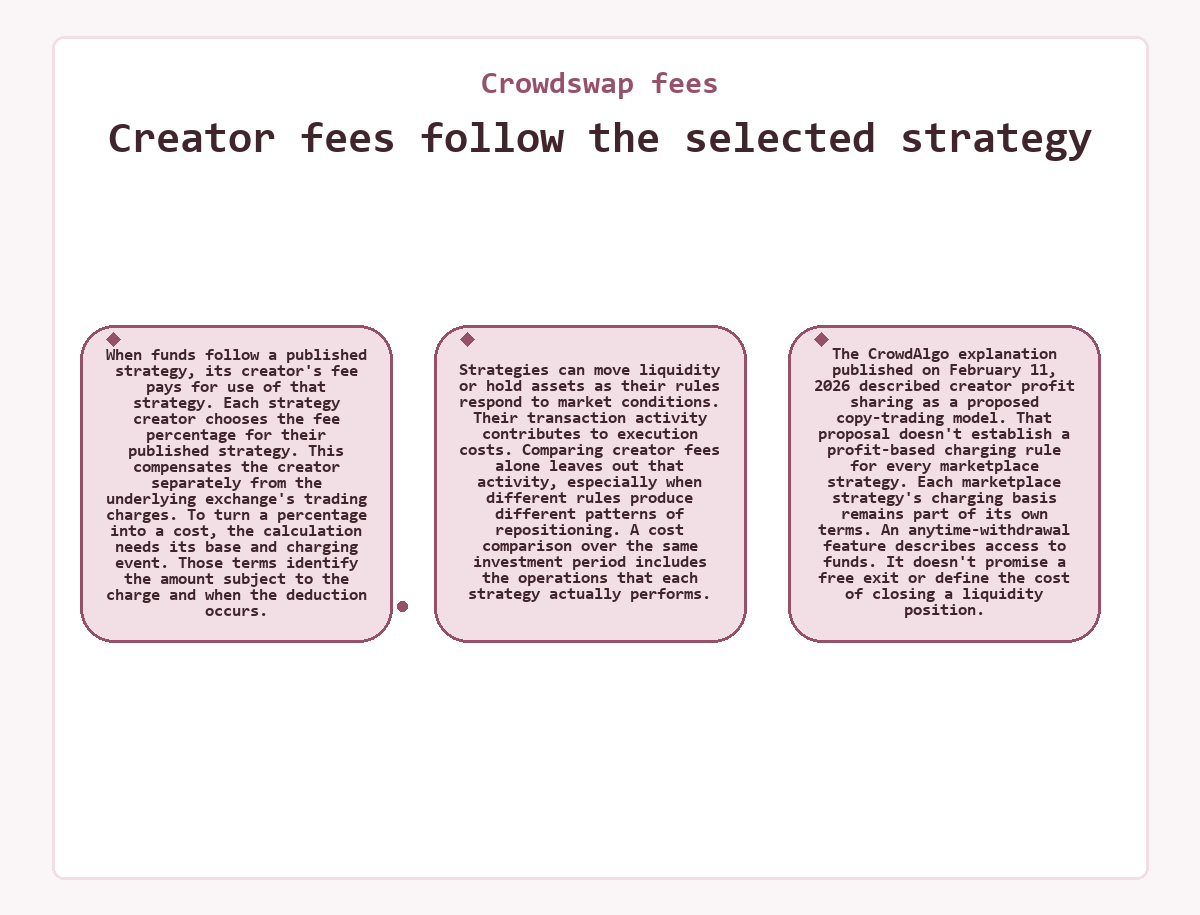
When funds follow a published strategy, its creator's fee pays for use of that strategy. Each strategy creator chooses the fee percentage for their published strategy. This compensates the creator separately from the underlying exchange's trading charges.
To turn a percentage into a cost, the calculation needs its base and charging event. Those terms identify the amount subject to the charge and when the deduction occurs.
Strategies can move liquidity or hold assets as their rules respond to market conditions. Their transaction activity contributes to execution costs. Comparing creator fees alone leaves out that activity, especially when different rules produce different patterns of repositioning. A cost comparison over the same investment period includes the operations that each strategy actually performs.
The CrowdAlgo explanation published on February 11, 2026 described creator profit sharing as a proposed copy-trading model. That proposal doesn't establish a profit-based charging rule for every marketplace strategy. Each marketplace strategy's charging basis remains part of its own terms.
An anytime-withdrawal feature describes access to funds. It doesn't promise a free exit or define the cost of closing a liquidity position.
Pool income and strategy charges affect different sides of returns
For a Uniswap v3 liquidity position, fee income accrues only while its liquidity remains within its chosen price range. That income is distinct from a creator's strategy fee. Trading volume and active liquidity influence earnings, while execution and creator fees reduce the amount retained. An advertised yield therefore isn't a complete fee schedule. Comparing strategies requires the same treatment of gross income, included deductions, and separately payable costs; a reward percentage can't substitute for those details.
CrowdAlgo's February 2026 batching model shares execution costs
The CrowdAlgo public-beta design described on February 11, 2026 batches transactions across participants to reduce individual execution costs. Its comparison is with managing the same strategy independently. Any saving concerns shared execution, and its size depends on the operations and costs involved. A cost comparison keeps the underlying strategy and period consistent, then accounts for the charges that apply to each implementation.
CrowdWallet changes the asset used to pay gas
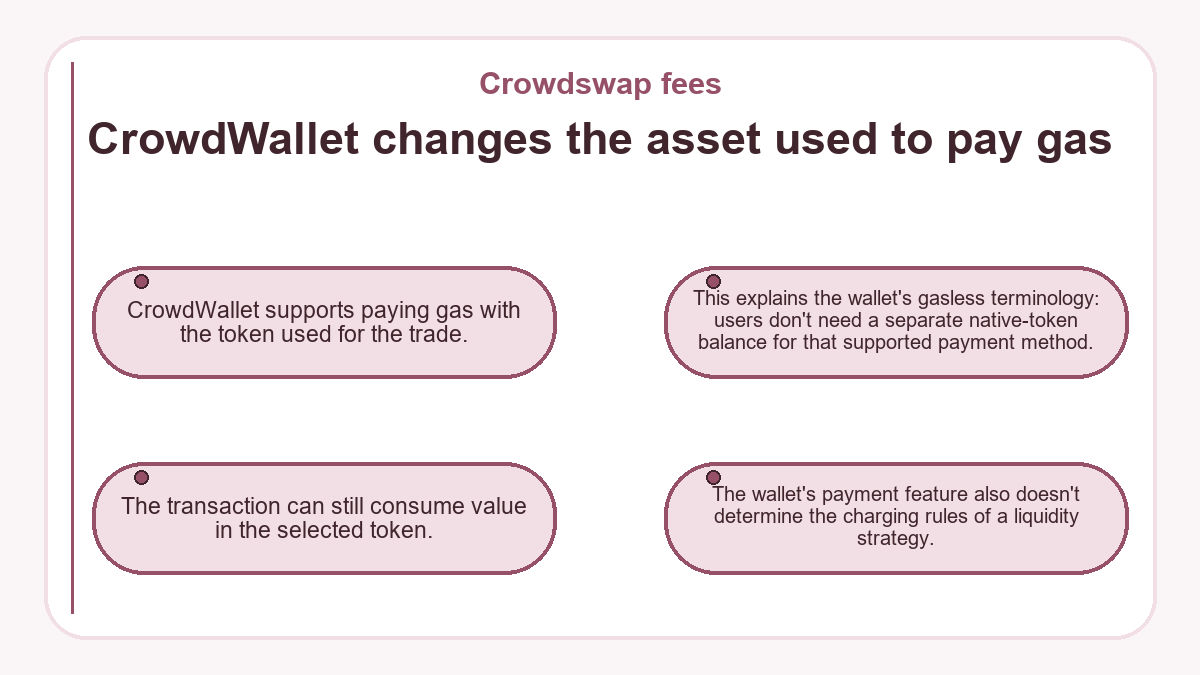
CrowdWallet supports paying gas with the token used for the trade.
This explains the wallet's gasless terminology: users don't need a separate native-token balance for that supported payment method. The transaction can still consume value in the selected token. The wallet's payment feature also doesn't determine the charging rules of a liquidity strategy.
Net output makes swap costs comparable
A swap comparison needs the same input amount, token pair, networks, and valuation basis. Quoted output can already reflect fee deductions. Adding those fees again understates the expected proceeds. The cross-chain API distinguishes
fees
from
includedInOutputFees
. That distinction prevents treating every reported fee amount as another deduction. Different token denominations also need a common valuation basis before their costs can be combined.
Price impact affects the exchange price when a trade changes the pool's balance. Slippage describes the difference between an expected price and the execution price. Those effects can change proceeds separately from an explicit charge. Keep the quote's included deductions and separately payable gas distinct, so the comparison neither counts the same fee twice nor overlooks an additional payment.
Key questions about Crowdswap fees
Can VIP revenue sharing reduce the quoted cost of every cross-chain swap?
VIP revenue sharing distributes program revenue to eligible members and doesn't establish a rebate on every swap. The program's cross-chain reward applies to transactions that use platform liquidity pools with CROWD as the intermediary token. It excludes CROWD bridges. A participant's allocation follows the program's VIP rules, separately from the quoted transaction charge.
Who receives referral commission from an embedded swap widget?
The affiliate identified by the widget's affiliate ID can receive a share of fees generated by referred trading. This commission concerns the relationship between the platform and the referring site. Its existence doesn't establish a customer rebate, and a referral commission percentage alone doesn't establish the fee charged on the trader's swap.
Why can a refreshed swap estimate show a different cost?
A refreshed estimate can reflect updated prices, network costs, or a different exchange route. Each estimate reflects conditions when the route is calculated. Comparing an earlier estimate with a later one requires matching the input amount and networks, as well as identifying any route change. A changed quote alone doesn't identify a platform fee increase.
Does purchasing a token basket eliminate its trading costs?
Combining token purchases into a basket can reduce separately initiated transactions without making the purchase free. The product called a DeFi ETF groups selected tokens into one purchase. Its potential transaction savings don't establish a blanket exemption from platform, trading, or network charges. The applicable basket's entry terms determine the actual cost.
How should token units and valuation fields be read in a fee response?
A fee amount needs its stated unit before it can be compared with another amount. The API separates token amounts from valuation fields identified in USDT. For any amount expressed in base units, the token's decimals control conversion to readable units. Don't apply that conversion again to a field that already represents a valuation amount.
Which records help reconcile swap charges after trading?
Transaction history and the relevant blockchain transaction help reconcile completed swap costs. The portfolio tools provide search, filtering, and export for transaction history. Those records concern actual activity, while an earlier estimate describes expected costs. Keeping the estimate alongside completed transaction records makes differences in quoted and actual costs easier to identify.